

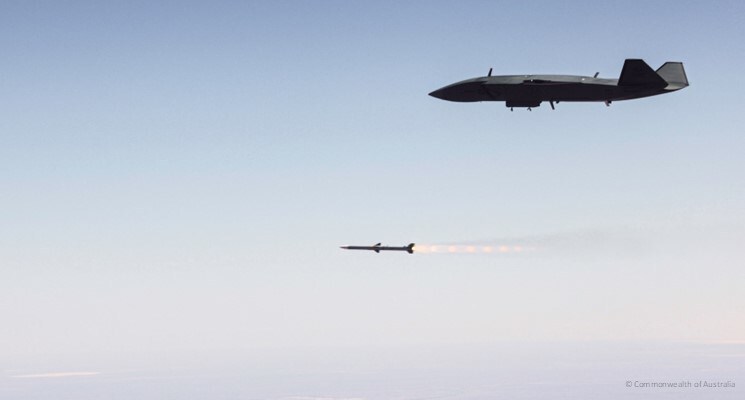
Boeing and the Royal Australian Air Force (RAAF) have successfully executed a force-integrated, air-to-air autonomous weapon engagement from an MQ-28 Collaborative Combat Aircraft (CCA).
Landmark Mission
The landmark mission involved an MQ-28 Ghost Bat teaming with a RAAF E-7A Wedgetail and an F/A-18F Super Hornet to destroy a fighter-class target drone.
“This is the first time an autonomous aircraft has completed an air-to-air weapon engagement with an AIM-120 missile, establishing the MQ-28 as a mature combat-capable CCA,” said Amy List, managing director of Boeing Defence Australia. “This latest achievement proves the advantage specialized CCA platforms bring to defense forces’ mission effectiveness, delivering increased operational mass and data exchange for informed decision-making while reducing cost and crewed pilot risk.”
Mission Execution Highlights
- The MQ-28, E-7A, and F/A-18F launched from separate locations.
- Once airborne, an E-7A operator took custodianship of the MQ-28, ensuring safety and engagement oversight.
- The F/A-18F teamed with the MQ-28 in combat formation to provide sensor coverage. Once the Super Hornet identified and tracked the target, targeting data was shared across all three platforms.
- The MQ-28 adjusted its position, received authorization from the E-7A to engage, and successfully destroyed the target using a Raytheon AIM-120 AMRAAM missile.
Technical Maturity
“This exercise demonstrates the maturity and sophistication of Boeing’s mission autonomy solution, which is built on open standards and government architectures and is capable of integrating with fourth, fifth, and sixth-generation aircraft,” said Colin Miller, vice president and general manager for Phantom Works, Boeing Defense, Space & Security’s advanced research, development, and rapid prototyping division. “It is a true example of speed-to-capability. The team implemented open architectures and an advanced digital ecosystem to develop the necessary hardware, software, and mission systems required to successfully integrate, test, and employ the weapon in a live, operationally relevant scenario in under eight months.”
