

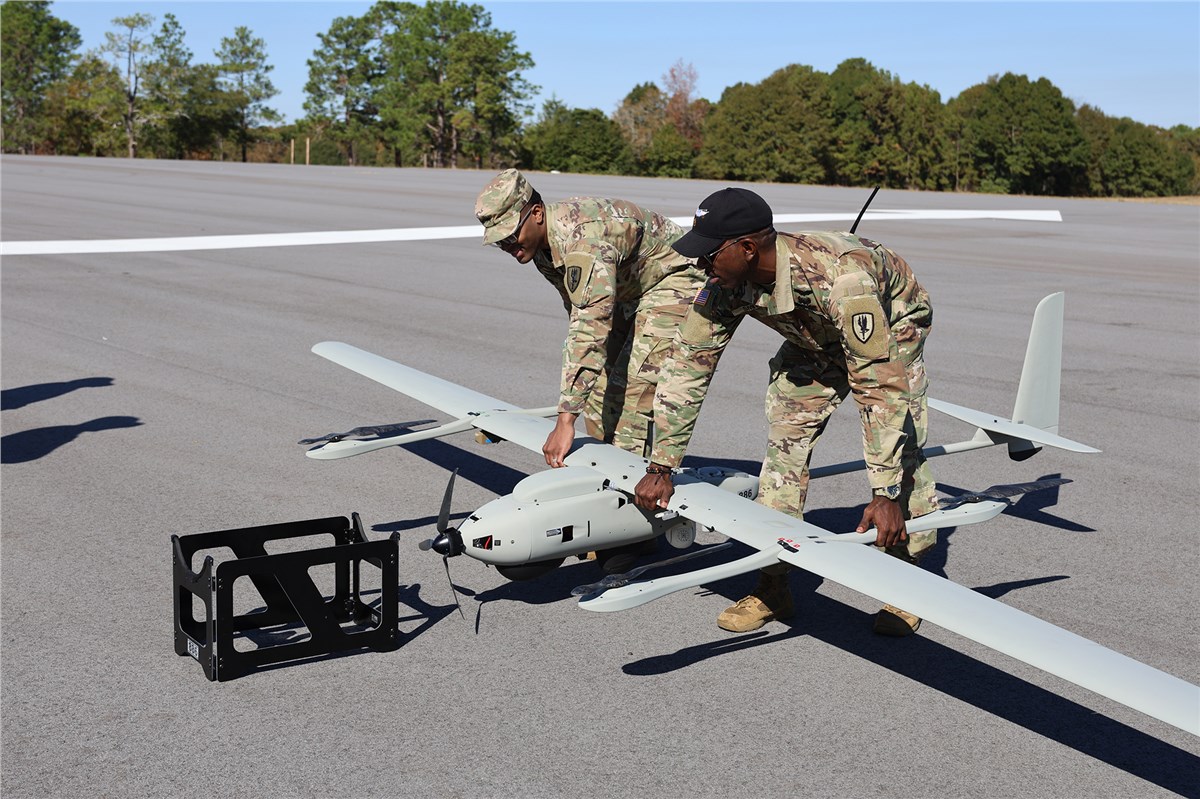
With the ability to easily integrate a wide variety of payloads—including droppable munitions—the Stalker UAS is used extensively for training Army UAS operators. In response to the evolving needs of the modern battlefield, the U.S. Army continues to expand its training programs, including the development of an Unmanned Advanced Lethality Course (UALC) at Fort Rucker, Alabama. The course evaluates and defines UAS performance across warfighting environments and ensures drone pilots can be trained quickly on systems to employ kinetic effects from FPV and sUAS drones.
Army Acquisition and Training
The Redwire Stalker UAS from Edge Autonomy was recently identified for acquisition by the Army Aviation Center of Excellence, and the Army moved quickly to implement the system for training to ensure students gain hands-on experience with the latest reconnaissance technology.
“More soldiers trained on the Stalker today means more of our warfighters are ready to operate this platform on the battlefields of tomorrow,” said Joshua Stinson, Chief Growth Officer at Edge Autonomy. “A mature and combat-proven UAS, the Stalker is seen as the system of choice for long-range reconnaissance training and operations. Thanks to the system’s flexible architecture, the Army is fully able to integrate leading third-party technologies that are needed to facilitate mission readiness, keep our warfighters safe, and achieve American drone dominance.”
Demonstrated Flexibility
In training demonstrations for the U.S. Army’s 1st Aviation Brigade at Fort Rucker, the Stalker drew attention for its flexibility compared to legacy systems. With its small logistical footprint, near-silent forward flight, and mission-adaptable payload integrations including droppable munitions, the Stalker stood out at the UALC and is preparing soldiers for tactical missions at battalion and brigade level echelons.
Adapting to Evolving Mission Requirements
Smaller Group 2 and Group 3 UAS are increasingly called upon to perform operations formerly met by larger, heavier, and less modular aircraft. Beyond intelligence, surveillance, and reconnaissance (ISR), these smaller UAS must demonstrate the ability to fly farther, fly longer, and carry a wider variety of payloads—including droppable munitions. Built with a modular open systems approach (MOSA), the Stalker is uniquely positioned to easily adapt to multiple mission requirements, saving time and money while supporting evolving operational needs.
Lethality Demonstrations
The Stalker flight operations team completed multiple successful live drop munition demonstrations featuring Drop Glide Munitions from Orbital Research. All munitions impacted within very close proximity of the target, with results witnessed by the 75th Ranger Regiment and Army leadership. This demonstration followed the Stalker’s exceptional performance at the 1st Aviation Brigade’s lethality course at Fort Rucker, which is part of the Army’s overall strategy to advance long-range reconnaissance (LRR) capabilities and drone dominance.
“The Stalker was selected for this training program due to the system’s open modularity, maturity, ease of use, and rapid order-to-delivery capabilities,” said Andy Ward, Business Development Director of U.S. Army and Americas at Edge Autonomy.
As the first Group 2 UAS used in the UALC—replacing legacy systems like the larger Group 3 Shadow system—the Stalker’s VTOL capability, near-silent acoustic footprint, and ability to easily integrate third-party systems make it an ideal fit for training soldiers on leading-edge UAS technology.
